
Video or image
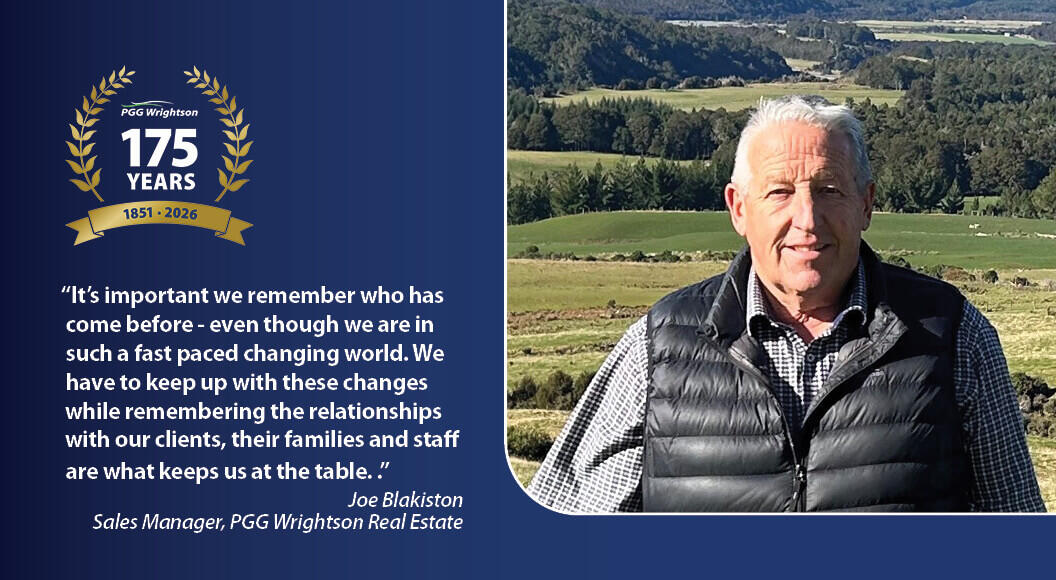
More than forty years of people, property, farming and livestock: The Joe Blakiston story
When Joe Blakiston reflects on more than 40 years with PGG Wrightson and its predecessor companies, there is one theme that comes up time and time again.
"It's the people."
Not the deals, the properties, the stock sales or the titles. For Joe, a career that has spanned some of the biggest changes in rural New Zealand, it has always been about the relationships formed along the way - although his path into the industry was hardly via a carefully mapped-out career plan.
His first job was as a lifeguard at Geraldine High School's swimming pool, long before David Hasselhoff made the role famous. And during the school holidays Joe worked for Dalgety, driving trucks and gaining his first taste of rural business.
“As a child, visits to the old PGG store in Geraldine were a regular occurrence. One memorable character was "Gunner" Watt, an ex-soldier who worked at the store and ensured young visitors left with liquorice allsorts from the grocery department.”
After leaving school, Joe headed to the University of Canterbury, where he completed his first year of a Bachelor of Arts. Looking back, he jokes that he could have become Minister of Education, complete with sandals, socks and cardigans. But life had other plans.
Following the death of his mother in 1982, Joe found himself reassessing his future. So, having grown up around stock firms through his father (a Geraldine lawyer), and family connections within the rural sector, he decided to give the industry a go.
Joe applied for positions with Wrightson, Dalgety, Canterbury Farmers and PGG, which resulted in three rejection letters and not one job offer.
"I still have the letters," he laughs.
So then there was a phone call to his godfather, the legendary Jimmy Balfour - a decorated World War II fighter ace and well-known rural personality - who may or may not have had something to do with what followed.
“I told him I had applied for a job at PGG, and Jimmy said ‘I had better see what old sore tooth Bernie Brown (the Christchurch Branch Manager) is up to’.
“Next minute I’ve got a job interview in a smokey, first floor den in the Cashel Street office with Brown, Woods, Farrant and Basset.”
A moment later, Joe was joining the infamous PGG mailroom in the year 1983 - a time he describes as a different era where as long as you had a piece of paper in your hand, you could do anything.
“Morning tea often involved rubbing shoulders with rugby legends - like Hoppy, Wyllie, Tane, Norton, Grizz, McCormick - and rural leaders, while mailroom duties included collecting catering for board meetings.
“There was always plenty of food, so we used to rearrange it and have a few snacks before delivery - that was until the board secretary had a stern word to us that it wasn’t actually going unnoticed.
“I may have also spent a bit of time shopping over the road at Hallensteins, where one time I ran into Humphrey Gould. He knew me by name and I had a bit of explaining to do.”
In 1985, PGG sent Joe on an Outward Bound course at Anakiwa, an experience he still describes as one of the best investments the company ever made in him. And the following year he moved into the livestock division as a stock agent in St Andrews, which was the beginning of a career that would take him across some of New Zealand's most iconic farming country.
“From Fairlie to Omarama, Albury to Mt Cook, I got to work closely with high-country farmers during the boom years of the fine wool industry. The annual Tekapo sales became legendary events, attracting huge numbers of sheep and some equally memorable characters.
“I remember one of the local high country identities famously climbed into a sale pen and told bidders to stop offering such ridiculous prices for old merino sheep. They were well over $200 and almost $300 per head”
The social side was just as memorable - client versus PGG cricket matches at Simon's Pass Cricket Ground became the stuff of legend. And throughout those ‘golden’ years, mentors played a significant role. Livestock manager Peter Walsh had an enormous influence on Joe's career, alongside Jimmy Balfour, with lessons that extended well beyond livestock and sales.
In 1992, Joe's career took a different direction when he accepted a field officer role in Timaru, moving into finance and broader branch operations. This eventually led to executive responsibilities and, in 1996, oversight of real estate in South Canterbury.
To support the transition, Joe completed his AREINZ studies and Diploma in Real Estate, an industry that would become a major part of his career for the next three decades.
But along the way, Joe witnessed some of the toughest periods rural New Zealand has faced.
“Rogernomics and the removal of farming subsidies dramatically reshaped the sector, sheep values collapsed, farm debt became crippling for many, and difficult decisions had to be made. I was involved in rural bank discounting of farm debt where the suffocating farm debt was dealt with on individual cases. Some survived – some didn’t.
Forces of nature also knocked on the front door many a time, from droughts, to floods, snowstorms, rabbit plagues and earthquakes.
Farm staff and stock agents would be flown into remote properties with little more than a sandwich, wet-weather gear and instructions to start digging sheep out of snowdrifts.
"I still tell people I've had more helicopter take-offs than landings, as you would fly out in a helicopter and while it hovered above the snow, you would just jump out.”
The earthquakes that affected Marlborough and Kaikōura created another set of challenges, cutting off communities and disrupting businesses for years. And the worst floods in South Canterbury were in 1986, where Joe remembers he was looking after a client’s farm in St Andrews.
“They always had the best two-tooths in the district but the flood took away a whole heap of them. I found some in the river flats and others in the trees.
Yet, as always, relationships remained at the centre of the recovery.
For Joe, real estate and livestock have always shared similarities.
"Some people used to call us the fighter pilots of the company as we had a license to go anywhere.”
But while major property sales can grab the headlines, Joe believes success comes from respecting everyone involved.
“I was trained to respect all clients, include both spouses, and know the kids names as well as the dogs. You always talk to all farm and station staff too as they are actually the ones who know what is going on.”
The greatest challenge of Joe’s life came in 2019 with the loss of his son Jimmy following a medical incident while overseas. It was a devastating time for Joe and his family, but what remains with him today is the support they received from colleagues throughout PGG Wrightson. And his daughter Lucy Blakiston (most recently crowned Young New Zealander of the Year and who is well known as a great story teller like her dad) also has fond memories of the PGG ‘family’.
Lucy recalls, “I would’ve been like four or five and every Friday night there were fish and chips and after work drinks at the old offices in Blenheim. All the kids would run around the merchandise room and into the meeting rooms - I also remember taking over the whiteboards and trying to write down every single word I could remember in my life (so obviously I've always been a bit of a writer).
“Me and my brothers have known some of the people who work there our entire lives, so it really does feel like a family. And it’s interesting because I don't think this in the day and age you stay at businesses for that long - 43 years! It’s quite amazing.
“It’s been such a constant in our lives, and they have certainly looked after him and us over the years.”
Beyond work, Joe has spent decades giving back to the communities he serves. Whether through rugby refereeing, fundraising, charity auctions, emceeing events or supporting local organisations, community involvement has always been part of the job.
Auctioneering, in particular, remains a passion.
"It gave me confidence and sharpened my language and wit."
Today, after more than four decades in the industry, Joe remains passionate about both the future and the history of the company. He is currently helping organise gatherings for former staff from across the many businesses that eventually became part of PGG Wrightson.
For him, preserving those connections matters.
“I love the history of the company and am arranging a branch past staff members morning tea - inviting all the ex-staff members of all the companies.
“They make up the fabric of who we are and most people in provincial NZ will have a connection in some way with PGG, Dalgety, Wrightson, Fruitfed, Williams & Kettle etc.
“It's important we remember who has come before - even though we are in such a fast paced changing world. We have to keep up with these changes while remembering the relationships with our clients, their families and staff are what keeps us at the table.
After 40 years, it's still all about the people.
We're celebrating 175 years alongside rural New Zealand. Read the next story.
Related News
Video or image
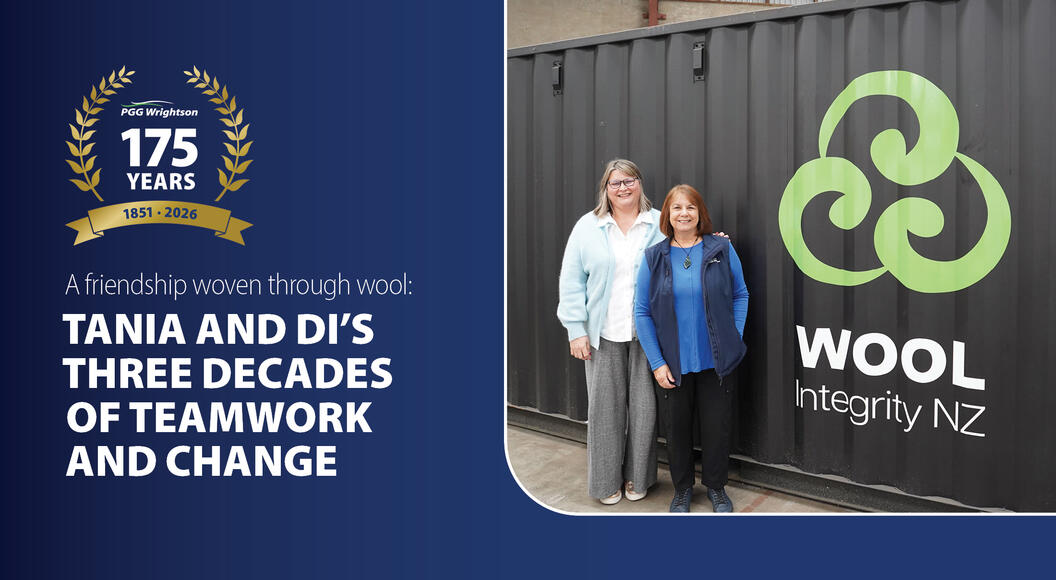
A friendship woven through wool: Tania and Di’s three decades of teamwork and change
When Diane Hermansson (Di) joined Tania Stockton at work for what was meant to be two weeks back in 1996, neither could have predicted that they would still be working side-by-side almost 30 years later. Today, Tania is Shipping and Finance Manager for Bloch & Behrens Wool (NZ) Ltd, a subsidiary of...
Video or image

From fighter pilot to stock agent: The remarkable life of Jimmy Balfour
Every family has its storytellers. For the Balfours, many of those stories begin with Jimmy. Depending on who you ask, Robert Hamish ‘Jimmy’ Balfour will either be remembered as the decorated fighter pilot who took on impossible odds over the Pacific, the stock agent who could somehow convince...
Video or image
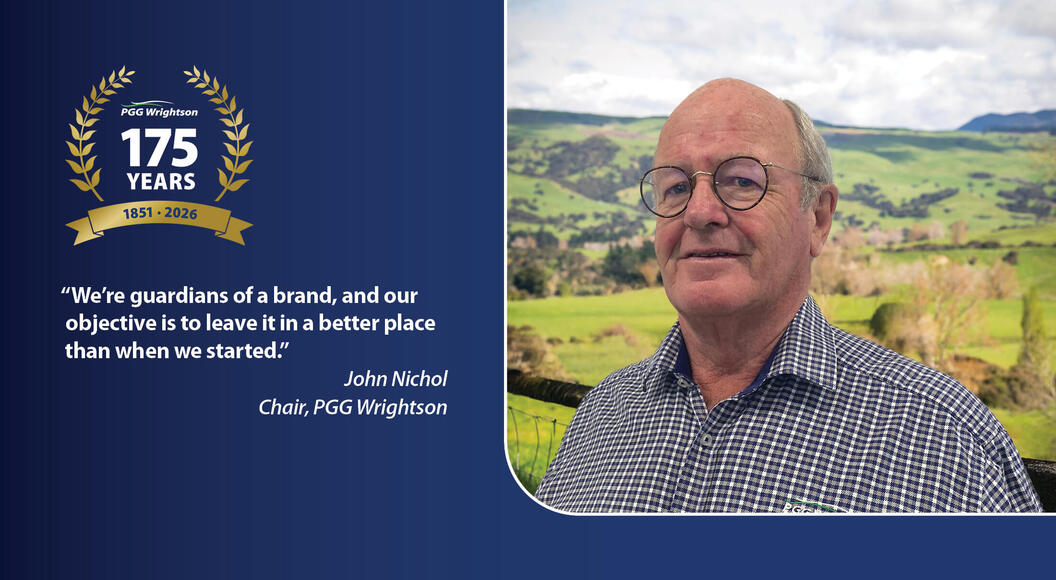
More than a chair on the Board: How PGG Wrightson has been woven through John Nichol's life
For John Nichol, PGG Wrightson has never simply been a company he has chaired or served on the board of. Long before joining the boardroom, its predecessor businesses were intertwined with his family's story, his career and, ultimately, his belief in the importance of New Zealand's rural sector...
Video or image
A friendship woven through wool: Tania and Di’s three decades of teamwork and change
When Diane Hermansson (Di) joined Tania Stockton at work for what was meant to be two weeks back in 1996, neither could have predicted that they would still be working side-by-side almost 30 years later. Today, Tania is Shipping and Finance Manager for Bloch & Behrens Wool (NZ) Ltd, a subsidiary of...
Video or image
From fighter pilot to stock agent: The remarkable life of Jimmy Balfour
Every family has its storytellers. For the Balfours, many of those stories begin with Jimmy. Depending on who you ask, Robert Hamish ‘Jimmy’ Balfour will either be remembered as the decorated fighter pilot who took on impossible odds over the Pacific, the stock agent who could somehow convince...
Video or image
More than a chair on the Board: How PGG Wrightson has been woven through John Nichol's life
For John Nichol, PGG Wrightson has never simply been a company he has chaired or served on the board of. Long before joining the boardroom, its predecessor businesses were intertwined with his family's story, his career and, ultimately, his belief in the importance of New Zealand's rural sector...