
Video or image
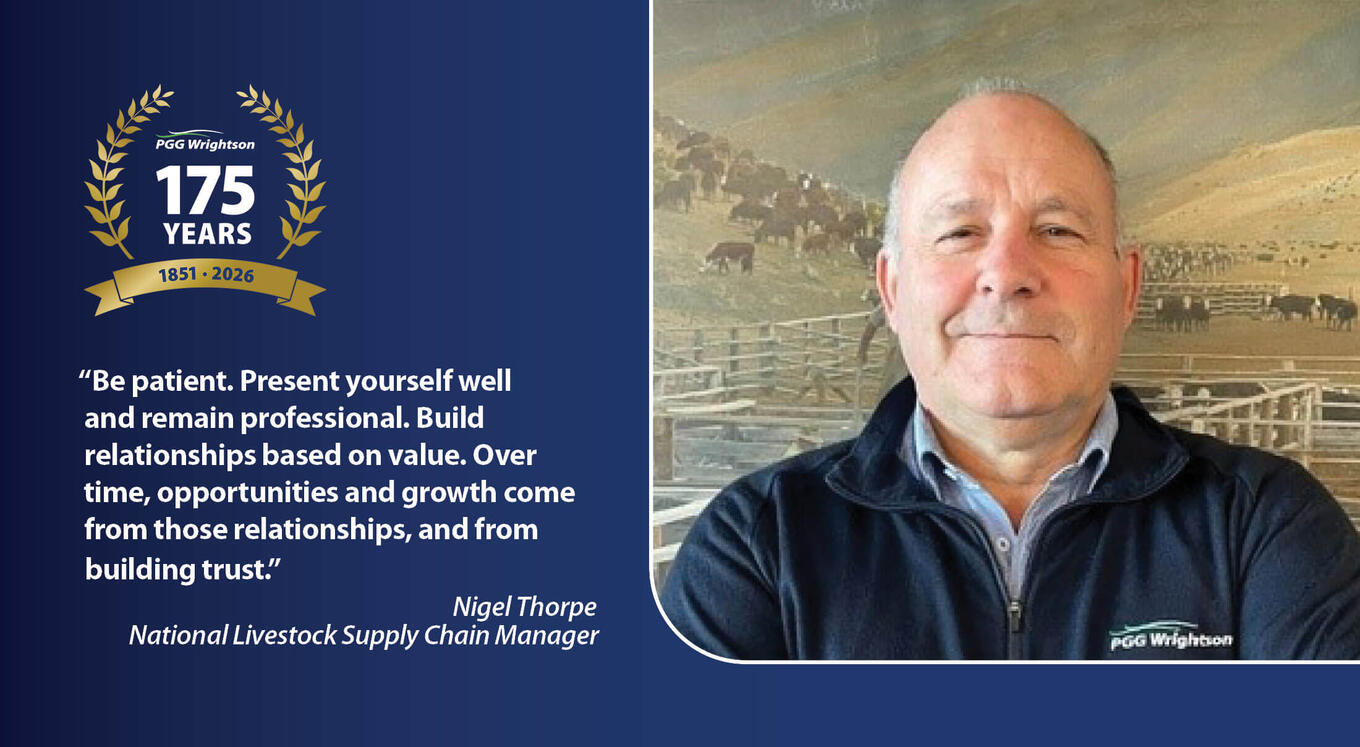
Nigel Thorpe: A career built on stock & station and relationships
When Nigel Thorpe started work with Dalgety NZ Ltd in Greymouth on February 15, 1982, his first job was sweeping floors out the back of the store as an office junior. Present day, and nearly 45 years later, Nigel is the National Livestock Supply Chain Manager for PGG Wrightson and is now looking back on a career that has spanned generations of farmers, major shifts in rural New Zealand, and some of the biggest changes the livestock sector has ever experienced.
Yet despite the scale of change, he says the fundamentals of the industry have never really altered.
“It’s all about people,” he says. “Great mentors and good people taught me about livestock and selling livestock and I wouldn’t change what I did for anything.”
After leaving college, Nigel began work with Dalgetys in Greymouth, and it didn’t take long before he found himself drawn to livestock. Then, by the end of 1982, he was transferred to Canterbury, working on the mail desk for a period and then into the stock department where he’d be out learning to draft stock with the older agents - as well as being the junior at the Addington Saleyards.
“I remember spending 3 days a week walking the bricks at the Addington Saleyards, especially the night drafting beats. You’d learn by watching, listening, working under instruction and getting stuck in,” he recalls.
Then, in 1984, Nigel transferred to Hororata as a junior livestock representative under respected stock agent Fred Fowler who, at 83, can still be seen buying lambs at Canterbury Park today. Nigel says Fred is one of the industry stalwarts who taught him a lot early on, including the fact that in those days, livestock representatives were deeply woven into the fabric of rural communities.
“If you go back to the early 80s, farmers would still come into town on a Friday to see their doctor, their accountant, in some cases their minister, and their stock and station firm branch manager. Sometimes not in that order! They’d drop their accounts off to their stock firm’s accounts department to be paid and get some cash out of the cash drawer then go to the store to buy some supplies, and head home.
“Back then, the stock firm was a big part of their weekly lives.”
By 1985, Nigel had transferred back to the West Coast with Dalgetys to cover South Westland as a livestock representative, servicing a vast region stretching from Barrytown to Haast, and it was those years which left a lasting impression on him.
“The farming families there taught me a lot - to name a few - the Fergusons, Sullivans, Scotts, Williams and Nolans. Many are now three generations on and the company is still doing business with most of them today. And many friendships still exist from those South Westland days.
“I also learnt about understanding the foundation of what makes for a good relationship, by doing what you say you’re going to do, and helping your clients to build value. And when the farmers reap the rewards, there’s repeat business, which then flows through to the next generation.”
From there, Nigel’s career progressed quickly. By his mid-twenties, he was already managing livestock teams and leading branches - first in Dannevirke for Elders Pastoral and later in Gore for both Elders Pastoral and Reid Farmers - where he helped grow livestock operations during the rapid dairy conversion years of the 1990s. In 1997 Reid Farmers took over Southland Farmers Co-op and Nigel relocated to Invercargill as Southland Livestock Manager for the company.
“Those were exceptional years in Southland,” he says. “The industry was changing quickly, change of land use was huge, dairy conversions were taking off, and there was huge growth and expansion happening across the rural sector in Southland.”
In 2001 Reid Farmers & Pyne Gould Guinness merged, and at that point Nigel transferred to Christchurch and was appointed to Pyne Gould Guinness as the General Manager of Livestock.
Over his time in the industry, Nigel became known not just for livestock expertise, but for building teams and developing people.
“From a young age I had opportunities to build teams where growth came pretty quickly thereafter. “That side of the job - helping younger staff develop, merging teams together and watching people grow and develop into leadership roles - has always been rewarding. I was lucky to have worked with some pretty good livestock agents and teams over a long period of time.”
In 2005 Pyne Gould Guinness & Wrightson merged to become PGG Wrightson, and at this time Nigel was appointed as General Manager Livestock, a position he held twice up until 2014.
Across the decades, Nigel worked through the evolution of several of New Zealand’s best-known rural servicing businesses as the sector consolidated and reshaped itself. And while the company names above the door changed over time, he says the biggest focus was always on the people behind them.
“The toughest part of any new merger or acquisition was always thinking about the staff and clients. How would they react? How would they adapt? That’s what mattered most.”
For Nigel, maintaining relationships and trust through periods of change became one of the defining challenges of leadership. And that relationship-driven approach remains central to how he views the livestock industry today, even as technology has transformed the pace of business - the introduction of mobile phones meant you could talk to farmers almost anytime and almost anywhere, and everything just became much faster.
“Farmers today are also more commercially focused and expect stronger value from service providers. So it’s more competitive now. Farmers want value, good systems, fast communication and good backup.”
And even though the tools for the job look a little different, Nigel believes the core skills required to succeed in livestock remain remarkably consistent.
“Listening and learning are still the most important things. Spend the time being taught, ask questions and be patient.”
Throughout all stages of his career, Nigel has worked alongside many influential leaders within the rural sector, including respected Board Chairs, Managing Directors and industry figures who helped shape both the companies and wider industry during periods of significant growth and challenge.
“There were a lot of good people all the way through. But equally important were the people at the coalface - the Reps, the support staff, the Livestock Managers. They were the ones holding the relationships with clients every day.”
Nigel also experienced some of the most volatile periods in modern agricultural business history, including the Global Financial Crisis in 2008, when a planned expansion into Australia abruptly stalled. After spending time in Melbourne as Australia's PGW General Manager for Livestock & Real Estate, helping establish livestock and real estate operations, he returned home as the economic environment shifted dramatically.
“The GFC hit and overnight the expansion halted,” he says simply.
Later in his career, Nigel moved across to Silver Fern Farms, taking up a South Island Beef Supply Chain Manager’s role before eventually returning once again to PGG Wrightson in 2022.
“It was great to experience and understand more fully the processing side of the industry. You learn a lot when you get to experience both sides of the full supply chain.”
Today, after more than four decades in the industry, Nigel remains passionate about rural New Zealand and optimistic about the future of farming, despite ongoing change and challenges.
“Younger people do things differently and that’s not always a bad thing as long as it's progressive,” he says. “Today's younger Livestock Reps need to be smarter, more prepared to learn and more adaptable to technology than ever before.”
And his advice to the next generation entering the livestock sector is straightforward.
“Be patient. Present yourself well and remain professional. Build relationships based on value and over time, opportunities along with growth come from those relationships and from building trust.
Nigel says he feels fortunate to have spent his career in an industry built around people, resilience and long-standing connections and while the businesses have evolved over the years, one thing that has never changed is the importance of the people, the brand and strong relationships between Livestock reps and the client.
“That’s still what this industry is built on.”
And at 62, Nigel reckons he has another another seven or eight years left in him yet - which of course is great news for PGW and the industry itself.
We're celebrating 175 years alongside rural New Zealand. Read the next story.
Related News
Video or image
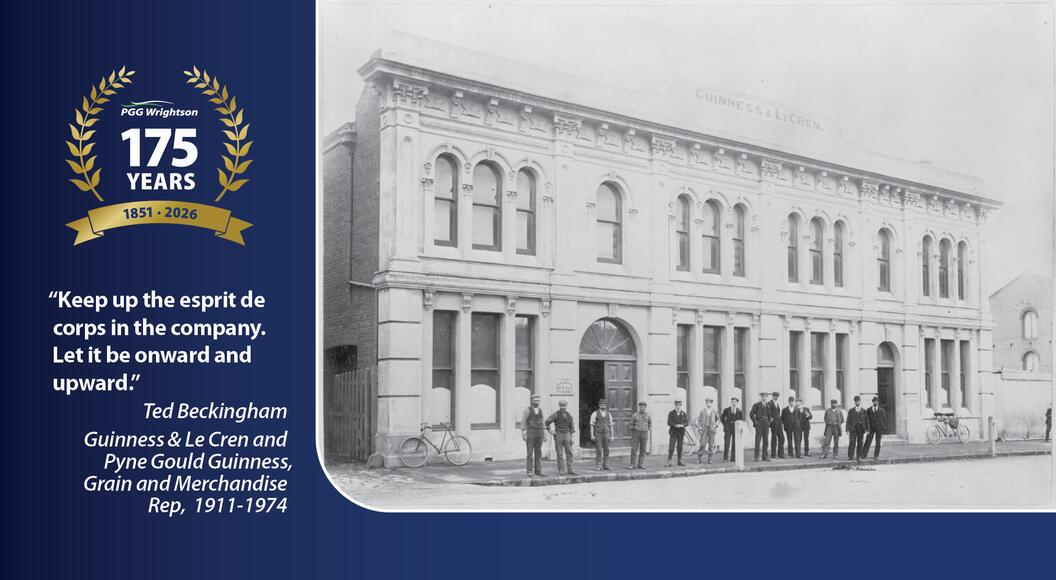
From ‘Toe Rag’ to trusted company man: Ted Beckingham’s memories of life at Pynes
When Ted Beckingham joined Guinness and Le Cren Limited in Timaru in September 1911, he was a 16-year-old office junior earning £26 a year. His official position may have been office boy, but the role came with another, less distinguished title - the ‘Toe Rag’. Decades later, Beckingham recorded his...
Video or image
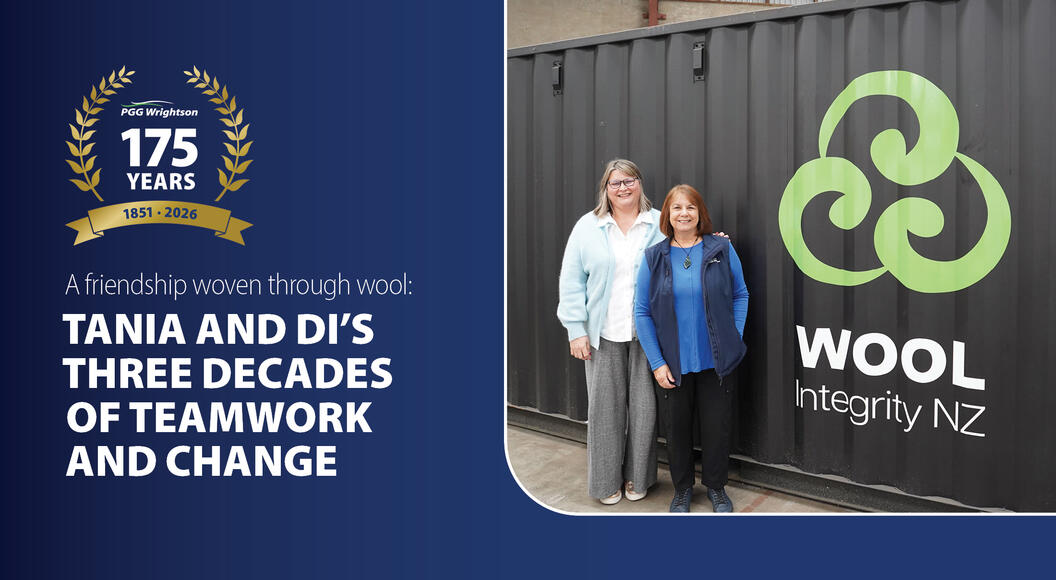
A friendship woven through wool: Tania and Di’s three decades of teamwork and change
When Diane Hermansson (Di) joined Tania Stockton at work for what was meant to be two weeks back in 1996, neither could have predicted that they would still be working side-by-side almost 30 years later. Today, Tania is Shipping and Finance Manager for Bloch & Behrens Wool (NZ) Ltd, a subsidiary of...
Video or image
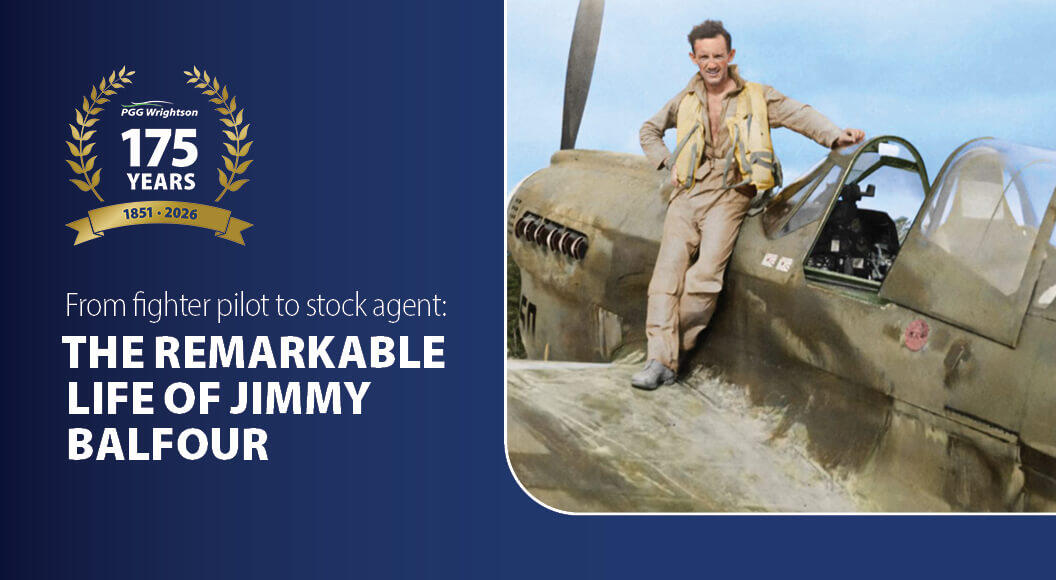
From fighter pilot to stock agent: The remarkable life of Jimmy Balfour
Every family has its storytellers. For the Balfours, many of those stories begin with Jimmy. Depending on who you ask, Robert Hamish ‘Jimmy’ Balfour will either be remembered as the decorated fighter pilot who took on impossible odds over the Pacific, the stock agent who could somehow convince...
Video or image
From ‘Toe Rag’ to trusted company man: Ted Beckingham’s memories of life at Pynes
When Ted Beckingham joined Guinness and Le Cren Limited in Timaru in September 1911, he was a 16-year-old office junior earning £26 a year. His official position may have been office boy, but the role came with another, less distinguished title - the ‘Toe Rag’. Decades later, Beckingham recorded his...
Video or image
A friendship woven through wool: Tania and Di’s three decades of teamwork and change
When Diane Hermansson (Di) joined Tania Stockton at work for what was meant to be two weeks back in 1996, neither could have predicted that they would still be working side-by-side almost 30 years later. Today, Tania is Shipping and Finance Manager for Bloch & Behrens Wool (NZ) Ltd, a subsidiary of...
Video or image
From fighter pilot to stock agent: The remarkable life of Jimmy Balfour
Every family has its storytellers. For the Balfours, many of those stories begin with Jimmy. Depending on who you ask, Robert Hamish ‘Jimmy’ Balfour will either be remembered as the decorated fighter pilot who took on impossible odds over the Pacific, the stock agent who could somehow convince...