
Video or image
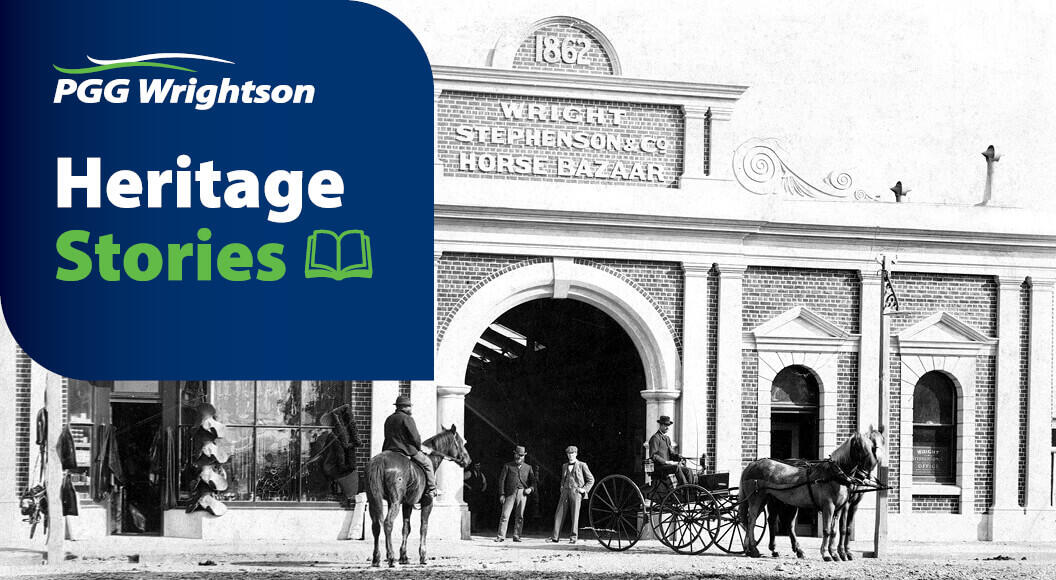
The origins of Wright Stephenson & Co
The name Wright Stephenson & Co is etched into the history of New Zealand agriculture as one of the most influential stock and station agencies of its time. Originally founded in 1861 in a small office in Manse St, Dunedin by John T. Wright and Robert M. Robertson, the company grew from a humble two-person company providing auctioneer, general merchant and wool broking services, to a powerhouse of rural services across New Zealand, Australia and England.
At the time the company was founded, the population of Otago was experiencing rapid growth, having more than doubled in population from the previous year to about 6,000. The discovery of gold in October 1861 had a tremendous impact on population growth, reaching about 30,000 by the end of 186. As a result, Dunedin became the commercial centre of New Zealand.
In 1861 John T. Wright and his friend Robert. M. Robertson immigrated from Melbourne to the rapidly growing settlement of Otago. Within weeks of their arrival, they set up Wright Robertson & Co, a general merchant and auctioneer in Dunedin. Auctioneer John Stephenson joined the company in partnership in 1865, and on the retirement of Robert Robertson, the duo carried on the business under the name of Wright Stephenson & Co.
John Stephenson was an outstanding auctioneer, with sharp instincts and a compelling voice. Described as ‘the most brilliant livestock salesman of his day' by Mr. J. A . Johnstone in 1920, he was admired for his sound advice and good humour. John Wright’s expertise lay in the finance operations of the business, and their complementary skills saw the business offer finance, shipping, wool exporting, and auctioneer services.
Soon after joining, John Stephenson organised horse sales which became a mainstay of the firm’s activities. The provincial growth brought on by the gold rush saw demand for horses reach an all-time high. With no railway system yet established and little in the way of mechanical farm machinery, the horse was an indispensable resource for both transport and livelihood. The coach service Cobb & Co, also established in Dunedin in October 1861, took the first four-horse coach to the goldfields in Gabriel’s Gully, reducing an arduous two-day horseback ride to a one-day journey. Horses were initially imported from Victoria and Tasmania. With the importation of the best Clydesdales from Scotland, NZ breeders established horse studs, and the tables were turned with an export trade established to Australia.
When the gold rush finally subsided in 1870, the region’s growth and economic conditions slowed, however wool exports remained a growth opportunity. With John Stephenson reportedly conducting the first wool sale auction in Otago, the firm was a key player in the early wool trade. Buyers from the USA (identifiable by the large, high-quality cigars they smoked) paid hefty prices to source the best crossbred and Merino wool from the Otago region.
Both partners retired in 1899, by which time the company had opened branches in Gore and Invercargill. Services had expanded to include finance to farmers, retail, merchandise, seed and manure sales, the handling of large amounts of grain produce, wool and livestock sales, as well as land sales.
More than a century later, in 1972, the company would merge with the National Mortgage and Agency Company of New Zealand to form NMA Wright Stephenson, and grow further into Challenge Corporation and eventually Wrightson Ltd. An evolution that paved the way for the 2005 merger with Pyne Gould Guinness Ltd and the creation of PGG Wrightson.
Discover more about our heritage
References:
L. A. T. Bell. The Wrightson: The Staff Magazine of Wright, Stephenson & Co Ltd, 1950.
J. C. Irving and L. A. T Bell. A Century's Challenge. Wright Stephenson & Co Ltd. 1861–1961.
Image:
Wright Stephenson & Co Ltd, Gore Branch, Southland. The horse bazaar & saddler's shop at the company's first branch at Gore, 1891. Fletcher Trust Archives P4009/1
Related News
Video or image
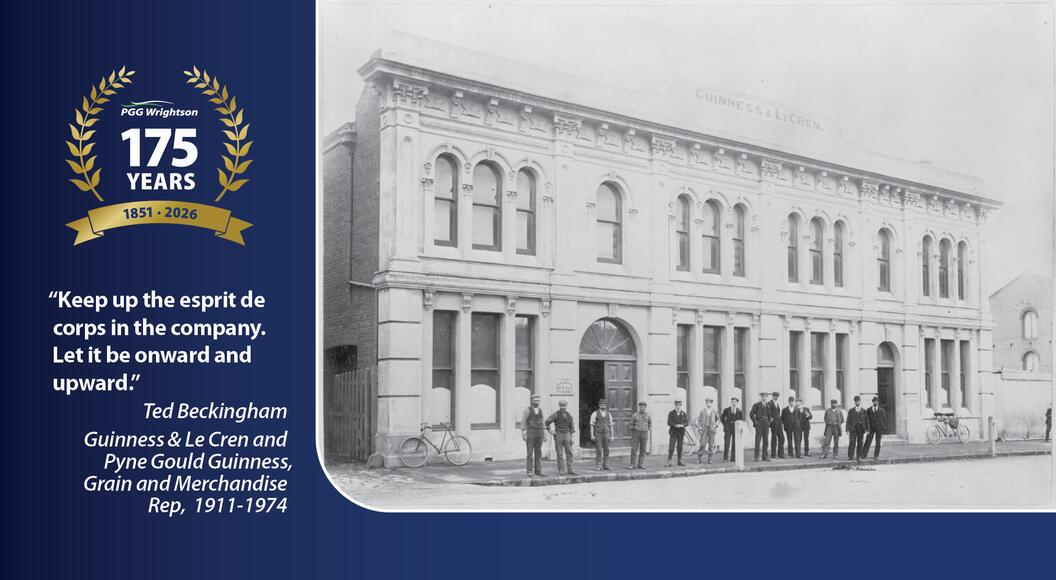
From ‘Toe Rag’ to trusted company man: Ted Beckingham’s memories of life at Pynes
When Ted Beckingham joined Guinness and Le Cren Limited in Timaru in September 1911, he was a 16-year-old office junior earning £26 a year. His official position may have been office boy, but the role came with another, less distinguished title - the ‘Toe Rag’. Decades later, Beckingham recorded his...
Video or image

A friendship woven through wool: Tania and Di’s three decades of teamwork and change
When Diane Hermansson (Di) joined Tania Stockton at work for what was meant to be two weeks back in 1996, neither could have predicted that they would still be working side-by-side almost 30 years later. Today, Tania is Shipping and Finance Manager for Bloch & Behrens Wool (NZ) Ltd, a subsidiary of...
Video or image
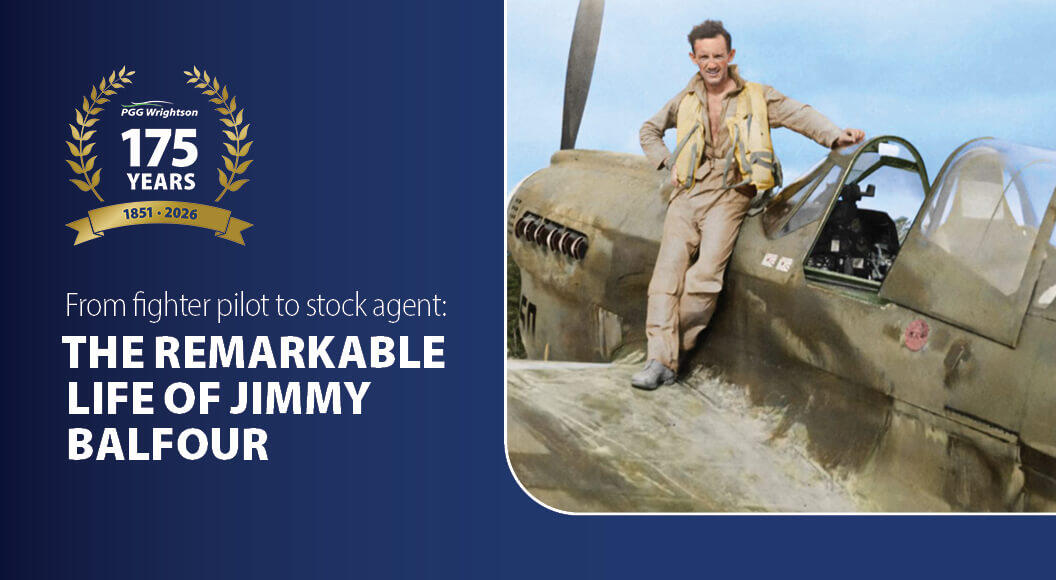
From fighter pilot to stock agent: The remarkable life of Jimmy Balfour
Every family has its storytellers. For the Balfours, many of those stories begin with Jimmy. Depending on who you ask, Robert Hamish ‘Jimmy’ Balfour will either be remembered as the decorated fighter pilot who took on impossible odds over the Pacific, the stock agent who could somehow convince...
Video or image
From ‘Toe Rag’ to trusted company man: Ted Beckingham’s memories of life at Pynes
When Ted Beckingham joined Guinness and Le Cren Limited in Timaru in September 1911, he was a 16-year-old office junior earning £26 a year. His official position may have been office boy, but the role came with another, less distinguished title - the ‘Toe Rag’. Decades later, Beckingham recorded his...
Video or image
A friendship woven through wool: Tania and Di’s three decades of teamwork and change
When Diane Hermansson (Di) joined Tania Stockton at work for what was meant to be two weeks back in 1996, neither could have predicted that they would still be working side-by-side almost 30 years later. Today, Tania is Shipping and Finance Manager for Bloch & Behrens Wool (NZ) Ltd, a subsidiary of...
Video or image
From fighter pilot to stock agent: The remarkable life of Jimmy Balfour
Every family has its storytellers. For the Balfours, many of those stories begin with Jimmy. Depending on who you ask, Robert Hamish ‘Jimmy’ Balfour will either be remembered as the decorated fighter pilot who took on impossible odds over the Pacific, the stock agent who could somehow convince...