
Video or image
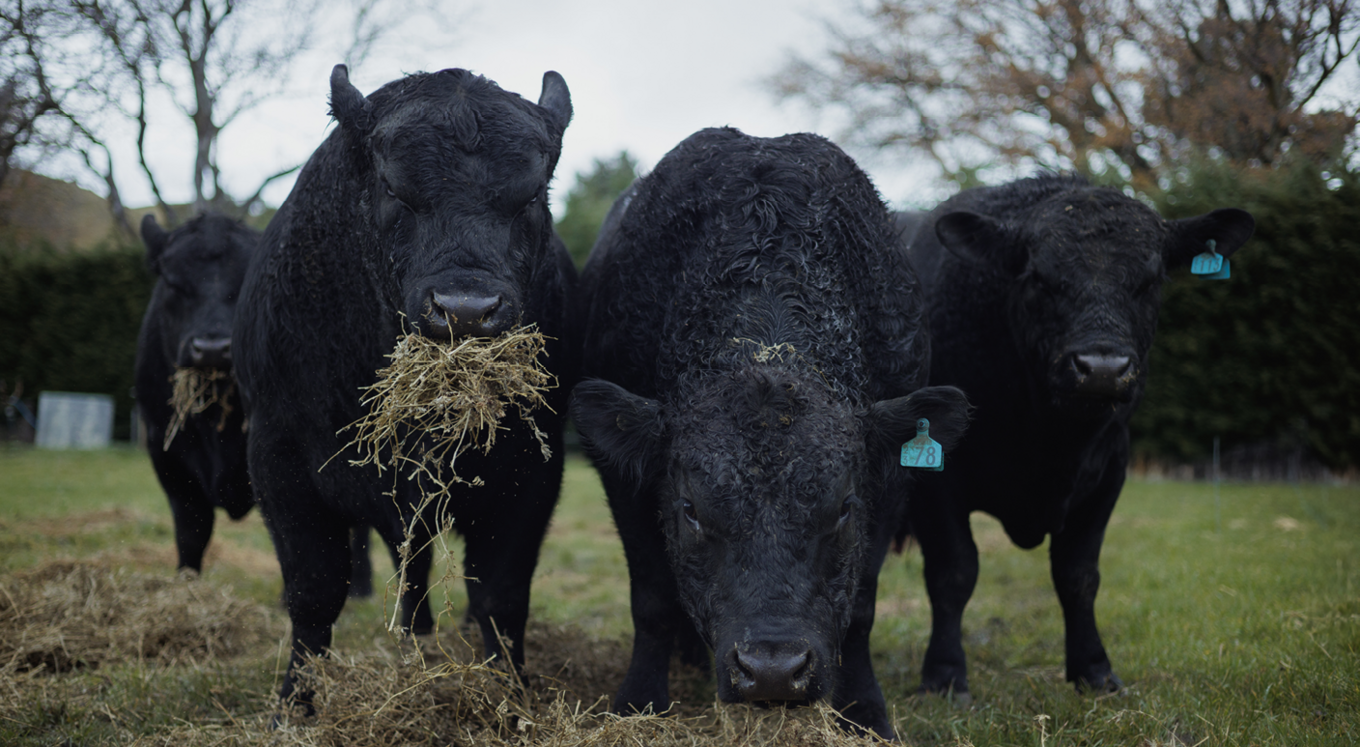
Positive trends suggest repeat of 2025 bull sales season
Several long-established studs set to mark important anniversaries in what could be another bumper year.
During last year’s two-year-old bull sales numerous records fell across the country.
With all the fundamentals continuing to support optimism in beef, this could also be a stellar year. However, as the 2026 bull sale season progresses, PGG Wrightson national genetics manager Callum McDonald says most stud stock businesses will be focused on the long term.
“Last year’s bull sale series was one of the best ever, with large crowds, full clearances and record prices. Positive trends still underpin the sector, and we expect many farmers will again seek to consolidate their advantage by acquiring the best genetics available.
“However, success in genetics derives from a long-term focus, which those studs celebrating significant milestones this year certainly demonstrate,” he says.
With the 2026 two-year-old bull sale season starting soon, a number of long established PGG Wrightson clients mark important anniversaries.
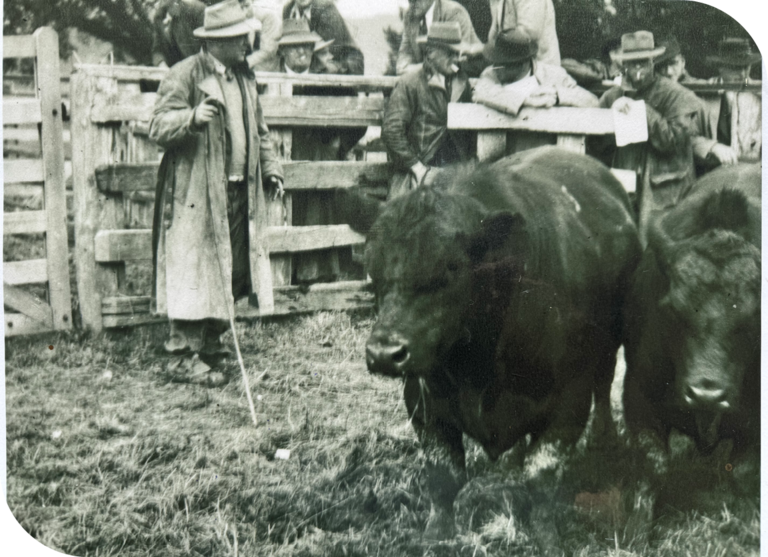
On 27 May Tarangower Angus, at Māhoenui, south of Te Kuiti, will hold its 80th on-farm bull sale, also commemorating the stud’s 100th anniversary.
Rob Purdie, who farms with his wife Nikki, is the fourth generation Tarangower stud manager on a property broken in by his great-great grandfather John Litterdale Purdie in 1905. Back then the first farmhouse at Tarangower was a two-bedroom punga cottage with a thatched nikau palm roof.
“At the end of World War Two, holding our annual sale on-farm was a better option than walking the bulls 66 kilometres to the Te Kuiti saleyards,” Rob says.
Pictured below: One of Tarangower Angus' first on-farm sales from the 1940's.
Although last year’s sale set a new highest average price record, anticipating this year’s sale, where Tarangower has catalogued 40 bulls, Rob is not jumping to conclusions.
“We are happy with the standard of bulls we have to offer, and prices across most stock categories are firm this year, though we can only sit back and see how buyers will react on sale day,” he says.
In advance of the landmark sale, Rob has been reviewing the family’s early history, which includes his great grandmother having to walk several kilometres of the three day trek home from New Plymouth after the coach broke down following the birth of one of her six children; a 1911 bush fire that wiped out more than 50 of their steers; and winters when the remote settlement was completely cut off for up to six months.
Tarangower bulls emphasise structural integrity, proven temperament and maternal excellence.
“Our cattle are raised under genuine Māhoenui hill country conditions, with no pampering and no supplements other than hay. We breed them to thrive on the hard hills, which sets them up to flourish elsewhere,” says Rob.
Also marking its 80th annual on-farm bull sale this year, on 4 June Maungahina near Masterton will offer approximately 42 Herefords, alongside some 16 Speckle Park bulls. Pictured below: First Maungahina Bull Sale 1946.
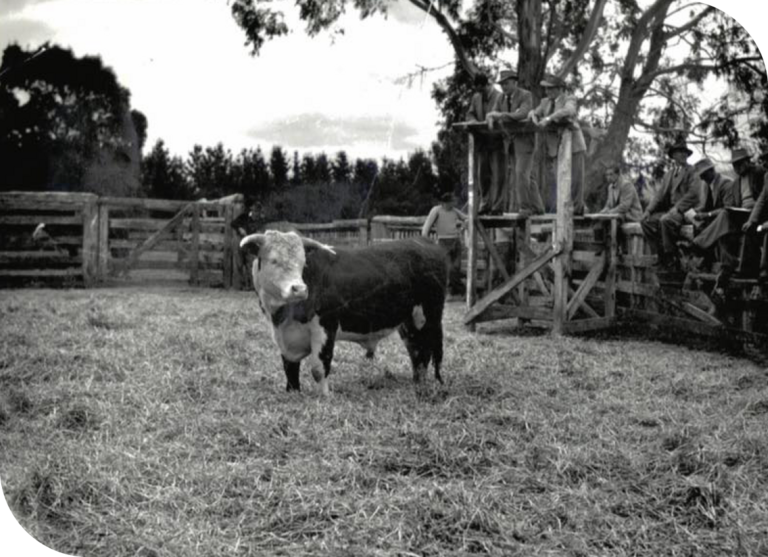
Mark McKenzie is the fifth generation of his family to run Maungahina, alongside wife Melissa.
“We focus on breeding bulls with extra power and grunt: plenty of muscle and bone and bigger than traditional Herefords.”
Building on 119 years of breeding Herefords, in the family’s sixth generation, Mark and Melissa’s daughter Molly started full time at Maungahina last year. Mark’s father Bruce, who was awarded CNZM in 2020 for his services to farming, is a leading international cattle judge, still intimately involved with the business and will be at the fore for his 79th on-farm Maungahina bull sale this year.
“We are looking forward to a special day. Our bull sale accounts for a significant proportion of our annual income, so we are very much on display.
“We are seeing more farmers coming back to cross breeding beef, taking advantage of hybrid vigour, which can add 30 to 40 kilograms at weaning. Our Speckle Park bulls also add great value when put over first cross cows. Based on high yield and intense marbling, meat quality is the key to this breed. Processing companies pay among the most generous premiums paid for carcasses with Speckle Cross genetics,” says Mark.
Maungahina has negotiated a special rate for clients staying at Masterton’s Solway Park hotel, and will provide shuttle buses to take them to and from the sale. Marking the 80th anniversary, a live band will also feature on the day.
Meanwhile one of the most remote studs in the country, Flagstaff Hereford, Mahitahi midway between Haast and Fox Glacier is marking its 50th anniversary with a bull sale on 23 May, offering 20 of its own bulls, plus others from David and Robert Scott of Bannockburn Angus.
Thomas Condon started the Flagstaff stud with four heifers purchased from a dispersal sale in 1976, and after initially selling his bulls at the annual Whataroa sale, has held an on-farm bull sale at Mahitahi since 1998.
“Our cows run in commercial conditions, unimproved grass growing on riverbed country, with five metres average annual rainfall. We have long term clients who have bought bulls from us right from the start. One recently sold lines of straight Hereford calves sired by Flagstaff bulls sold at the Ross calf sale for $2,540 each,” says Thomas.
Most Flagstaff bulls remain on the Coast, from the Grey Valley in the north to Haast in the south, while a few go all over the rest of the South Island: Canterbury, Nelson, Marlborough, and down to the Catlins.
Thomas imports semen straws from the United States and Australia.
“We select for toughness, reliability, and durability. Flagstaff bulls are known for fertility, calving ease and good IMF.”
Thomas manages the business alongside his partner Kate O’Shea. The farm is predominantly worked on horseback. Flagstaff operates on a quarter of the original family land, in the Condon family since 1880 when it was settled by the original Thomas Condon, and for six generations since.
The sales at Tarangower, Maungahina and Flagstaff will be run respectively by PGG Wrightson Livestock Genetics representatives Cam Heggie, Tom Suttor and Lisa Nolan. All three will also be on bidr.
For anyone who has not yet prepared one, a sound and factually based genetics programme to underpin stud purchases will maximise results.
Contact a PGG Wrightson Genetics Specialist, and focus on those breeders offering bulls that best meet the needs of your farm.
Related News
Video or image
Celebrating 175 Years at Stern Angus with The Country Live
From a partnership spanning 85 years to a milestone 175th anniversary, Stern Angus provides the perfect backdrop for a special live broadcast of The Country. On 7 October, PGG Wrightson will mark a significant milestone, celebrating 175 years of supporting New Zealand farmers and rural communities...
Video or image
Renowned CHB stud offers first ever on-farm ram auction
With traits to counter FE and worms, Marlow Genetics is preparing a sale catalogue with 30 Romworths and 50 Coopworth rams After 57 years, a prominent Central Hawke’s Bay stud is holding its first ever on farm ram sale. Along with his wife Rosa, in 2023 Jason Wyn-Harris took over Marlow Genetics...
Video or image
Good and bad weather affecting the mood, and the markets
Yearling bulls, calves, lambs and hoggets all meeting demand at North Island saleyards, while prolonged cold and wet delays the growing season in the South Variable weather conditions throughout the country have impacted throughput at the saleyards and the mood among farmers, with positive or...
Video or image
Celebrating 175 Years at Stern Angus with The Country Live
From a partnership spanning 85 years to a milestone 175th anniversary, Stern Angus provides the perfect backdrop for a special live broadcast of The Country. On 7 October, PGG Wrightson will mark a significant milestone, celebrating 175 years of supporting New Zealand farmers and rural communities...
Video or image
Renowned CHB stud offers first ever on-farm ram auction
With traits to counter FE and worms, Marlow Genetics is preparing a sale catalogue with 30 Romworths and 50 Coopworth rams After 57 years, a prominent Central Hawke’s Bay stud is holding its first ever on farm ram sale. Along with his wife Rosa, in 2023 Jason Wyn-Harris took over Marlow Genetics...
Video or image
Good and bad weather affecting the mood, and the markets
Yearling bulls, calves, lambs and hoggets all meeting demand at North Island saleyards, while prolonged cold and wet delays the growing season in the South Variable weather conditions throughout the country have impacted throughput at the saleyards and the mood among farmers, with positive or...