
Video or image
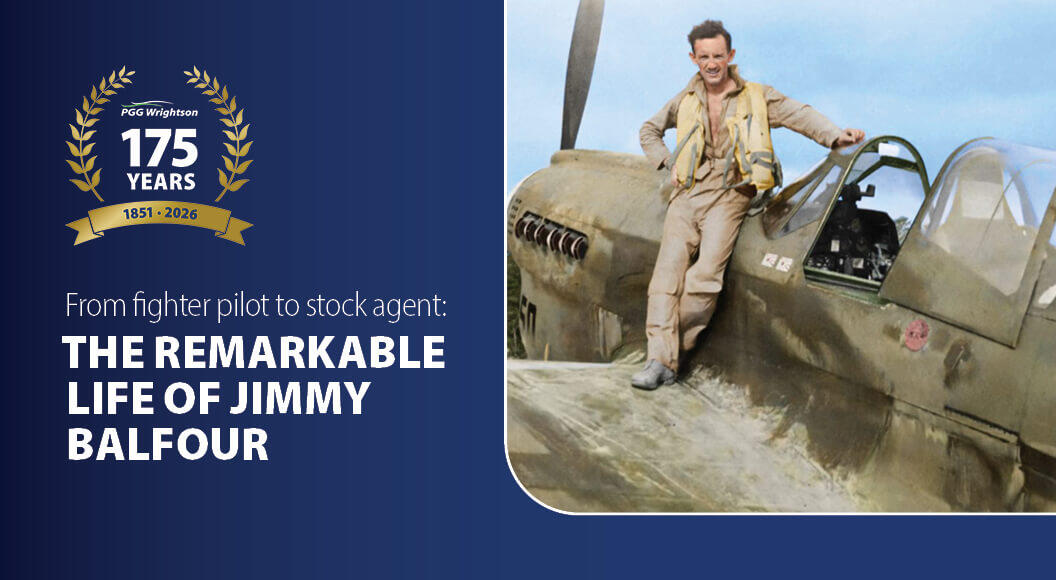
From fighter pilot to stock agent: The remarkable life of Jimmy Balfour
Every family has its storytellers. For the Balfours, many of those stories begin with Jimmy.
Depending on who you ask, Robert Hamish ‘Jimmy’ Balfour will either be remembered as the decorated fighter pilot who took on impossible odds over the Pacific, the stock agent who could somehow convince buyers to spend more than they intended, or the man who thought company cars and bonfires made perfectly reasonable companions. And again, depending on who you ask, most of them are true.
Born in Waimate in 1917, Jimmy grew up with farming in his blood. But like many young New Zealanders of his generation, his future changed dramatically when war arrived - in April 1940 he enlisted in the Royal New Zealand Air Force.
Training first at Taieri before moving through Wigram and Harewood, Jimmy quickly established himself as one of the Air Force's most capable pilots. In fact, he was so skilled that rather than being sent immediately into combat, he was kept in New Zealand to train others.
For nearly two years he instructed young pilots, many barely eighteen or nineteen years old, guiding 63 of them through their first solo flights.
"He always looked after his men," says Joe Blakiston, Jimmy’s nephew and godson first and foremost (and also a Blenheim-based real estate agent with PGG - who he often refers to as the ‘fighter pilots’ of the company).
But while he was renowned for his talent in the cockpit, Jimmy wasn't always known for following the rules.
One of the stories that has become part of South Canterbury folklore occurred in 1941 after he was given permission to fly to Waimate for his grandfather's funeral. After completing a respectful flypast and attending the service, temptation proved too much.
Flying his Tiger Moth home, Jimmy decided to give the town one more memorable farewell.
Eyewitnesses recalled him sweeping low along Queen Street, tipping the aircraft dramatically onto its side and giving the people of Waimate an unforgettable display. Local legend even insists he flew beneath the town's power lines, although that part has never been confirmed.
What is certain is that news travelled faster than he did and by the time Jimmy landed back at Harewood, his commanding officer was waiting.
He was given two choices - to face a court martial for dangerous low flying or accept the Commanding Officer's punishment. Jimmy chose the latter and this decision delayed his promotion and earned him the unusual distinction of becoming one of the longest-serving Pilot Officers in RNZAF history.
However, in true Jimmy form, it would not be the last time his confidence landed him in trouble.
By late 1942 Jimmy finally joined 17 Squadron before transferring to the newly formed 18 Squadron, flying the famous Curtiss P-40 Kittyhawk in the Solomon Islands. And within days of arriving in the Pacific, he was flying operational missions where the odds were daunting.
On one patrol over Empress Augusta Bay in November 1943, six New Zealand fighters encountered more than forty Japanese Zero fighters.
Most pilots would have looked for a way home, but Jimmy attacked. Diving straight into the formation, he destroyed two enemy aircraft during the engagement, helping 18 Squadron claim one of its most successful combat victories.
Over three operational tours he flew dozens of combat sorties, escorting American bombers, protecting Allied landings and attacking Japanese positions throughout the Solomon Islands.
He earned ‘Flying Ace’ status with four-and-a-half confirmed aerial victories and gained a reputation as an exceptional fighter pilot and in 1944 he was awarded the Distinguished Flying Cross by Britain for outstanding courage and leadership.
Later that same year he received the American Distinguished Flying Cross, becoming only the second New Zealander to receive both British and American DFCs for service in the Pacific.
Despite the medals, Jimmy rarely spoke about the war. Like many returned servicemen, he preferred to leave the memories where they belonged. Those who served alongside him, however, never forgot his courage.
American bomber crews reportedly refused to begin one operation when they discovered the New Zealand fighter escort had been stood down. The lead pilot radioed ‘Where are those Royal New Zealanders?’. When told they weren't flying that day, the bombers turned around and returned to base. It was one of the greatest compliments Jimmy ever received.
Yet for all his achievements in the air, the next chapter of his life would prove just as significant. When the war ended, Jimmy returned home and resumed work with PGG.
It was here, not in the cockpit, that many rural New Zealanders would come to know him best. Returning to civilian life was a challenge for many servicemen, but Jimmy slipped naturally into a career that suited both his personality and his love of rural New Zealand.
He rejoined PGG as a stock agent, beginning in Cheviot before later becoming an auctioneer in Timaru and eventually Branch Manager in Waimate. By the time he retired in 1975, he had devoted almost 40 years to the company.
If the Air Force had taught him discipline, the stock industry gave him an audience.
Jimmy became renowned as one of the great auctioneers of his era - he understood livestock, knew the market intimately and, perhaps most importantly, knew people. Jimmy could read a crowd, sense hesitation and somehow coax another bid from buyers who moments earlier had sworn they were finished.
"He could set a market," recalls Joe.
"He knew values and he knew how to get the best result."
Humour was one of his greatest tools, but beneath it was genuine professionalism. Clients trusted him because they knew he would work tirelessly on their behalf. If stock failed to reach the right price, Jimmy was known for negotiating well into the evening, often over a whisky or two, determined to secure the best possible outcome.
He also played an important role helping clients purchase some of the South Island's best-known farming properties, building relationships that lasted decades.
Just as importantly, he invested heavily in younger staff and one young person who benefited directly was Joe. After deciding university wasn't for him, Joe rang his uncle to say he was applying for a role with PGG in Christchurch.
Jimmy didn't leave anything to chance.
Picking up the phone to Christchurch Branch manager (and close friend) Bernie Brown, he delivered a characteristically direct recommendation.
"If you never do another thing for me, I want you to give this fellow a job. He might not be any good, but please do it."
Joe got the job and more than 40 years later, he still credits that phone call with launching his career.
Jimmy was fiercely protective of the people who worked for him and wasn't afraid to challenge management when he believed staff deserved better. On one occasion, he argued successfully that the company should pay relocation costs for a transferring stock agent who couldn't afford to move his family.
He also encouraged younger colleagues to advocate for themselves.
"Never wait to be offered a pay rise," he would tell them. "Always ask."
In fact, when he returned from the Pacific and was asked by PGG Chairman Derek WJ Gould if he’d like to come back to work for the firm and if so, what pay he expected, Jimmy reportedly said ‘I would want 20 quid a week (about 1000 pounds). Gould replied with ‘good god, you would be getting more than I am’, to which Jimmy said ‘do you want to swap jobs?’
He also drove the company cars with the same enthusiasm he had once flown fighter aircraft, prompting more than one conversation with management after a series of spectacular accidents.
His response became one more favourite story to add to the book.
"When I was flying aircraft in the islands," he joked, "I must have done thousands of pounds' worth of damage and they gave me medals. I prang a company car and they want to tell me off."
Or how about the time he had another car ‘accident’ and on being asked to explain, Jimmy tried to blame the car, saying it didn’t roll as well as his Kittyhawk.
Even retirement couldn't slow him down completely.
Horse racing became another passion, while his love of people, conversation and storytelling remained undiminished. And those who visited him later in life found the same sharp wit was still intact, once remarking that some visitors in Rannerdale Home seemed to have misunderstood their relationship.
"You know some of the people who come to visit me have got it wrong, because I don’t think they realise I’ve never really liked them," he quipped.
Jimmy passed away in 1996, but his influence continues to be felt. His military record remains extraordinary; four operational tours, two Distinguished Flying Crosses and one of New Zealand's most accomplished fighter pilots of the Second World War.
More than 25 years after his uncle's passing, Joe Blakiston still finds himself uncovering new pieces of a life lived to the fullest. Old logbooks, faded photographs, official records and handwritten notes have helped piece together the story of one of New Zealand's most decorated Second World War fighter pilots - and later, one of PGG's most respected stock agents and auctioneers.
And as PGG Wrightson celebrates 175 years, Jimmy Balfour's story serves as a reminder that the company's history hasn't only been shaped by milestones and mergers. It's been built by remarkable individuals whose character, courage and commitment left a lasting mark on rural New Zealand.
We're celebrating 175 years alongside rural New Zealand. Read the next story.
Related News
Video or image
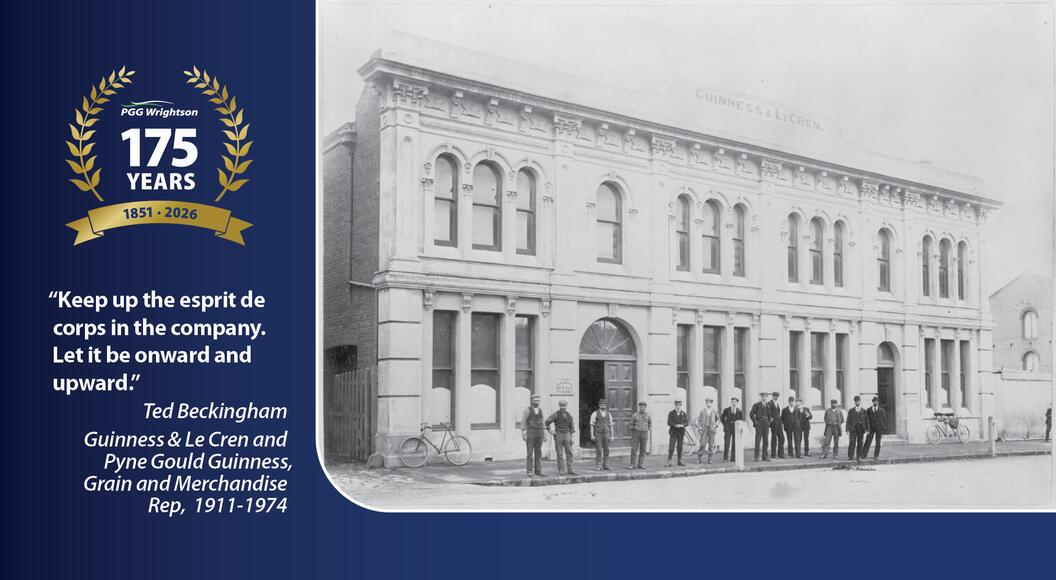
From ‘Toe Rag’ to trusted company man: Ted Beckingham’s memories of life at Pynes
When Ted Beckingham joined Guinness and Le Cren Limited in Timaru in September 1911, he was a 16-year-old office junior earning £26 a year. His official position may have been office boy, but the role came with another, less distinguished title - the ‘Toe Rag’. Decades later, Beckingham recorded his...
Video or image

A friendship woven through wool: Tania and Di’s three decades of teamwork and change
When Diane Hermansson (Di) joined Tania Stockton at work for what was meant to be two weeks back in 1996, neither could have predicted that they would still be working side-by-side almost 30 years later. Today, Tania is Shipping and Finance Manager for Bloch & Behrens Wool (NZ) Ltd, a subsidiary of...
Video or image
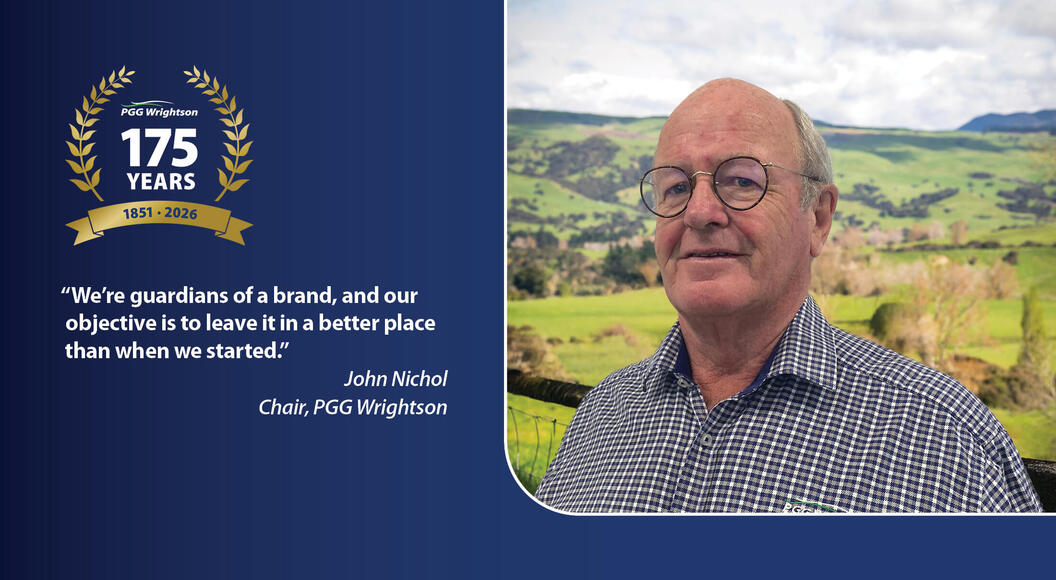
More than a chair on the Board: How PGG Wrightson has been woven through John Nichol's life
For John Nichol, PGG Wrightson has never simply been a company he has chaired or served on the board of. Long before joining the boardroom, its predecessor businesses were intertwined with his family's story, his career and, ultimately, his belief in the importance of New Zealand's rural sector...
Video or image
From ‘Toe Rag’ to trusted company man: Ted Beckingham’s memories of life at Pynes
When Ted Beckingham joined Guinness and Le Cren Limited in Timaru in September 1911, he was a 16-year-old office junior earning £26 a year. His official position may have been office boy, but the role came with another, less distinguished title - the ‘Toe Rag’. Decades later, Beckingham recorded his...
Video or image
A friendship woven through wool: Tania and Di’s three decades of teamwork and change
When Diane Hermansson (Di) joined Tania Stockton at work for what was meant to be two weeks back in 1996, neither could have predicted that they would still be working side-by-side almost 30 years later. Today, Tania is Shipping and Finance Manager for Bloch & Behrens Wool (NZ) Ltd, a subsidiary of...
Video or image
More than a chair on the Board: How PGG Wrightson has been woven through John Nichol's life
For John Nichol, PGG Wrightson has never simply been a company he has chaired or served on the board of. Long before joining the boardroom, its predecessor businesses were intertwined with his family's story, his career and, ultimately, his belief in the importance of New Zealand's rural sector...